


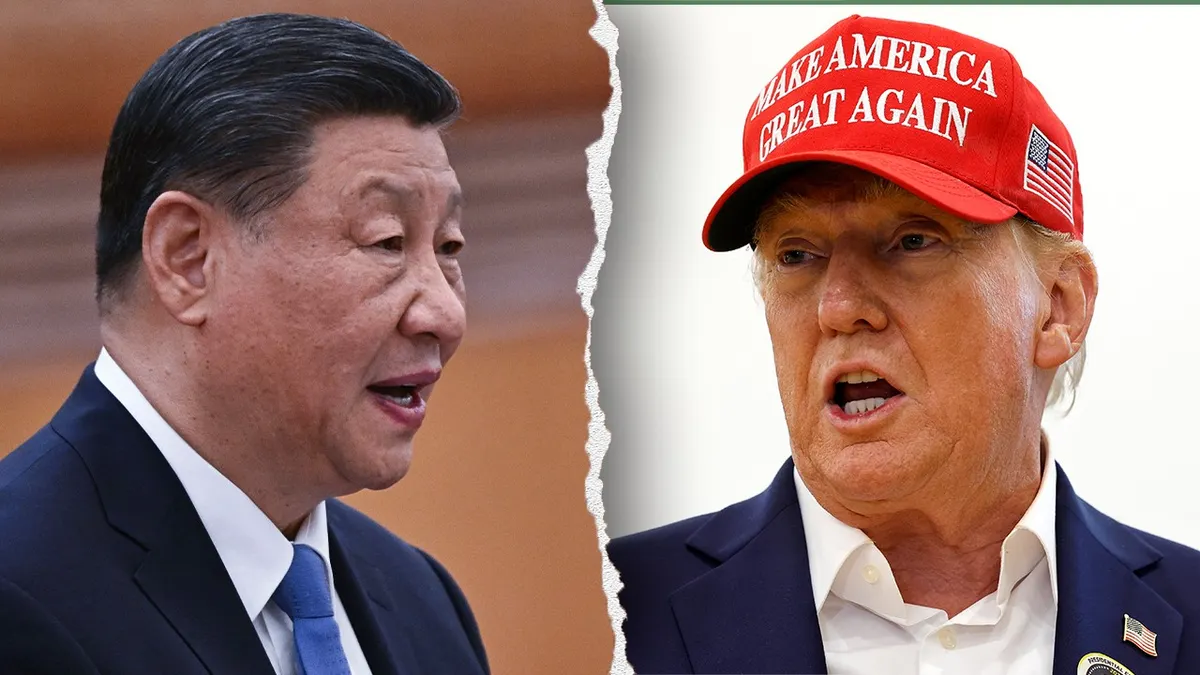
In one corner stands Donald J. Trump — the dealmaker, the negotiator, the man who sees the world as a high-stakes boardroom. In the other stands Xi Jinping — the strategist, the planner, the man who sees power as a chessboard.
The former preaches “The Art of the Deal,” where leverage, bluff, and momentum can bend markets. The latter embodies “The Art of War,” where patience, deception, and positioning win battles before they begin.
The Trade War That Never Ended
The so-called “trade war” between the United States and China was never just about tariffs or soybeans. It’s a fight over the architecture of global commerce — who sets the rules, who controls supply chains, and who defines the future of money, data, and technology.
Trump’s America wields economic disruption as a weapon. Tariffs, sanctions, and abrupt policy reversals create shock and uncertainty — tools of negotiation in his worldview. Washington believes chaos creates concessions.
Xi’s China, by contrast, plays the long strategic game. It absorbs the pain, studies the opponent’s psychology, and counters not with emotion but with systemic adaptation. When Trump slaps a tariff, Beijing subsidizes, reroutes, or builds new capacity. When Washington bans chips, China accelerates domestic semiconductor research. Each punch only hardens its resolve.
The Battle Lines of Economic Supremacy
Supply Chains: The New Front Line
China still controls vast portions of the world’s manufacturing backbone — and, more crucially, dominates the refining of rare earths and advanced materials essential for defense, EVs, and chips. This gives Beijing a quiet but potent weapon: it can choke the arteries of Western production without firing a shot.
Technology: The Crown Jewel
America still leads in innovation — semiconductors, software, and biotech. But export bans, such as restrictions on AI chips, are double-edged. They slow China’s access but also encourage autarky, accelerating China’s push to become technologically self-sufficient. Xi is turning every Western sanction into a five-year plan.
Currency & Finance
The dollar remains dominant, but China is testing the global order with the digital yuan and bilateral settlements in local currencies. The goal isn’t to dethrone the dollar overnight, but to dilute its monopoly — to slowly create a multipolar monetary world.
Global Influence
While the U.S. tightens its circle of allies, China expands outward — Africa, Latin America, Southeast Asia — offering infrastructure, loans, and trade deals. Trump’s tariffs drove manufacturers out of China, but many didn’t return home — they went to Vietnam, Malaysia, and Indonesia, nations now linked to China’s orbit through the Belt & Road Initiative.
The Philosophical Divide: Power vs. Freedom
At its core, this is not simply a contest between nations, but between two economic philosophies. Xi represents the centralized model — the belief that planning, surveillance, and state control can outcompete messy Western capitalism. Trump represents a mercantilist variant of capitalism, where trade is war and deficits are trophies to be reclaimed.
Both models share one uncomfortable trait: they’re statist at heart. Xi’s control is absolute; Trump’s interventionism is selective but forceful.
Who Wins?
In the short term, China’s discipline and control give it an advantage in a prolonged economic siege. In the long term, the edge belongs to whichever side reclaims the principles of economic liberty.
If the United States chooses protectionism and industrial policy over free trade and open markets, it will slowly become what it fights — a planned economy run by bureaucrats. If China chooses control over creativity, it will trap itself in mediocrity.
The winner, ultimately, will be the nation that trusts individuals more than institutions — that unleashes capital, creativity, and choice.
The Libertarian Verdict
If Trump’s America doubles down on liberty rather than tariffs, it can win. If Xi’s China loosens control rather than tightening it, it can rise without coercion. But if both persist in economic nationalism, the only loser will be the global free market — and the individual standing behind every dollar, yuan, and trade.
In the end, neither the dealmaker nor the general will decide the future. The free man will.