


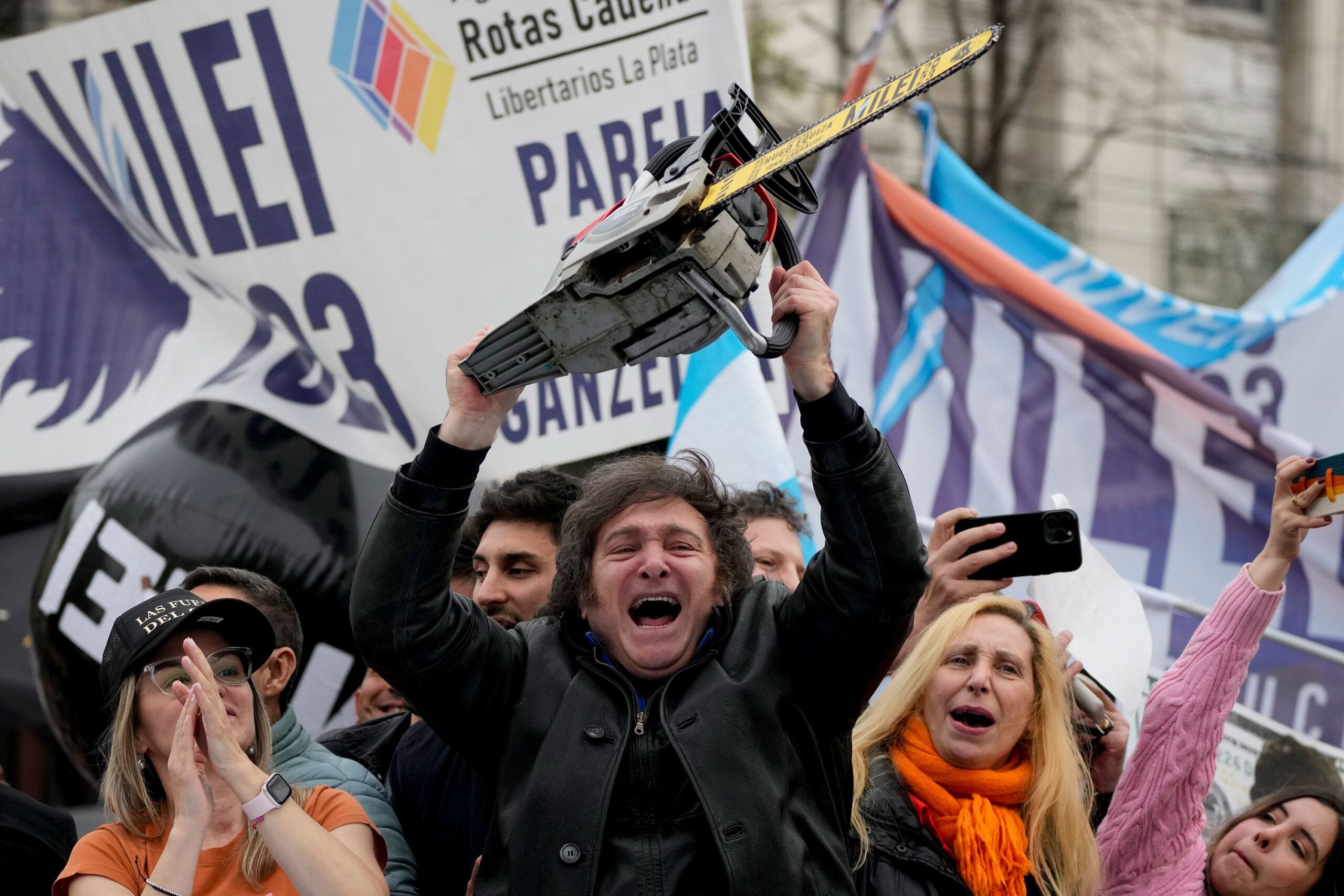
Let’s start with what Milei got right. Inflation in Argentina was at 211 percent when he took office in December 2023. It is now closer to 31 percent. The fiscal deficit — a festering wound decades in the making — has been largely closed. These are real achievements, and we acknowledge them.
But a libertarian publication owes its readers more than applause for stopping the bleeding. We must also ask: was this the liberation of Argentina, or just a different kind of cage? After more than two years in office, the evidence increasingly suggests the latter.
- 36.4% approval rating, March 2026 — his lowest since taking office
- $251M investor losses in the $LIBRA crypto rug pull he promoted
- 73,000 manufacturing jobs lost since he took office
The Central Bank he Promised to Abolish is Still Running
Milei’s signature campaign promise — the one that electrified libertarians worldwide — was to abolish Argentina’s central bank, the engine of the inflationary destruction that had robbed generations of Argentines of their savings. “The central bank is the biggest scam in history,” he declared. It is still open. Not reformed. Not constrained by a currency board. Open, active, and busier than ever.
The central bank is raising banks’ reserve ratios to limit currency in circulation. It is intervening in futures markets to contain the exchange rate. It is selling dollars from its reserves — without informing the public how many — to defend the peso band negotiated with the International Monetary Fund. The institution Milei promised to chainsaw has instead become his government’s primary economic stabilization tool.
Speaking of the IMF: the self-described anarcho-capitalist who rails against statist institutions has signed a $20 billion arrangement with the world’s most powerful supranational lender. This is not a minor technical point. The IMF comes with conditions, surveillance, and constraints on economic policy. Milei did not abolish dependence on global financial institutions — he deepened it.
The “Miracle” Was Built on Broken Wages
“Milei hasn’t fixed the engine of Argentina’s economy. He has simply turned it off.”
The inflation number looks astonishing on paper. But look at how it was achieved. Milei made the Argentine population too poor to participate in their own economy. Since he took office, manufacturing output has collapsed, with over 2,000 businesses shutting down alongside those 73,000 jobs lost. A “labour modernisation” law passed in early 2026 effectively increased working hours while reducing worker protections, prompting mass protests in Buenos Aires. Critics have described it as a return to 19th-century working conditions.
Wage suppression is not libertarian economics. It is not the free market at work. It is the engineered impoverishment of a population used as an inflation-control mechanism. Argentina’s real wages in 2026 have fallen to levels that surpass the suppression seen during the catastrophic 2001 crisis — the very collapse that scarred the national psyche and should serve as a warning, not a benchmark. GDP growth forecasts of 4 percent for 2026 sound encouraging until you realize that growth is concentrated in agriculture, mining, and lithium extraction — sectors that create very few jobs for the average urban Argentine.
Cryptogate: the Scandal that will not Die
On February 14, 2025, Milei posted to his millions of X followers promoting an unknown cryptocurrency token called $LIBRA, including a contract address that is not the kind of detail a casual observer would know. The token — created minutes before his post — surged past a $4.5 billion market cap within an hour. By morning it had lost 96 percent of its value. Approximately $251 million in retail investor losses followed in what specialists have described as a textbook “rug pull.”
Milei claimed he “did not know the details of the project” and later said he had merely “spread” information, not promoted it. That defense has since collapsed under the weight of evidence. Court documents from the ongoing federal investigation show Milei exchanged seven phone calls with Mauricio Novelli — a crypto lobbyist who introduced the token’s creators to the Milei orbit — on the night of the launch, both before and after his social media post. Prosecutors also found on Novelli’s phone a draft agreement describing a $5 million payment structure, and separate forensic analysis found evidence of recurring monthly payments from Novelli to Milei going back years before the launch.
A congressional investigative commission reviewed 10 technical and documentary files over three months and concluded that Milei used his presidential role to spread an “alleged scam,” that his image was exploited for profit, and that this was not his first such incident. Lawmakers cited earlier promotions of CoinX — later banned by securities regulators as resembling a Ponzi scheme — and the KIP Protocol token. When the commission summoned Milei and his sister Karina, who controls access to the president, neither appeared. The commission cited a “total lack of cooperation” from the administration.
Then, in March 2026, Milei dissolved the special investigative unit he himself had created to probe the scandal, declaring it had completed its “assigned task” — with no public report of its findings. A federal judge is still investigating. A class-action lawsuit is moving through US courts. The investigation is not closing. It is accelerating.
He Governs Like a Populist, Not a Libertarian
Libertarianism is not simply about cutting budgets. It is a coherent philosophical tradition built on individual liberty, the rule of law, institutional restraint, and a deep skepticism of concentrated power. By those standards, much of Milei’s conduct in office should alarm any serious libertarian observer.
In his first year, Milei suspended the entrance examinations for Argentina’s Foreign Service Institute — the first interruption since the return to democracy. In November 2024, following a clash with his own foreign minister, his government launched an “ideological screening” of the diplomatic corps to identify what officials called “agendas hostile to freedom.” By mid-2025, key appointees were steering Argentina toward negative votes at the UN on gender, indigenous rights, domestic violence, climate change, and the sustainable development agenda. Whatever one thinks of those issues, the use of loyalty tests to purge a professional civil service is not a libertarian act. It is the behavior of an authoritarian.
Milei spent an average of three hours a day on X in October 2025, attacking journalists, insulting governors, and berating legislators. Among his documented statements: “we don’t hate journalists enough.” He has made over 1,200 positive public references to Donald Trump on the platform, with zero negative ones — not the record of a principled independent thinker, but of a political client. His confrontational style has alienated legislative allies he needs, leaving his reform agenda stalled in a Congress he cannot move.
The Verdict
Milei inherited a country in genuine crisis and delivered genuine, if limited, stabilization. Inflation is lower. The fiscal position is better. Some deregulation has occurred. These are facts, and they matter.
But the central bank stands. The IMF is in charge of the macro framework. Wages have been crushed, not liberated. Manufacturing has hollowed out. A sitting head of state is under federal investigation for promoting what prosecutors increasingly believe was a coordinated crypto fraud that cost retail investors a quarter of a billion dollars. The administration stonewalled congressional investigators and then shut down its own inquiry. Approval has fallen to 36 percent.
Libertarians were right to be excited by the idea of Milei. The idea of a genuine radical reformer in Buenos Aires — someone willing to cut, deregulate, and roll back decades of Peronist statism — was thrilling. But ideas are not governments. Governments are judged by what they actually do. And what this government has actually done is fall well short of its promises, dress up wage suppression as monetary victory, and give us a president who appears to have used his office to enrich insiders at the expense of ordinary investors.
Argentina deserved better. So did libertarianism.