


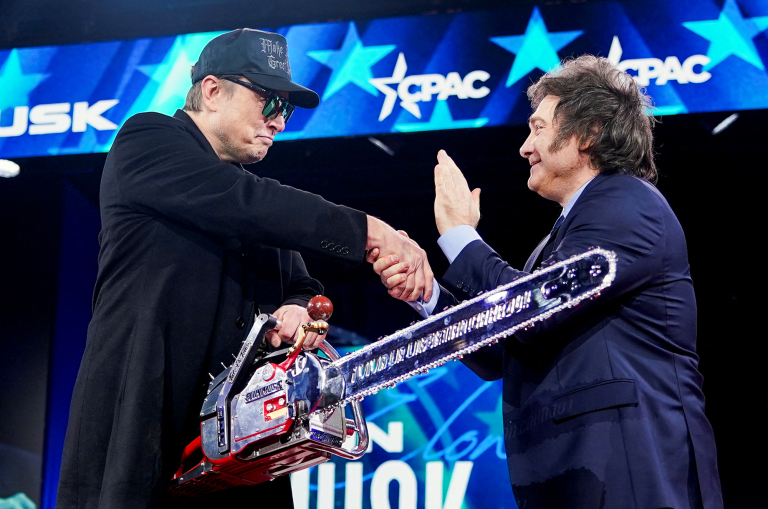
Over the past year, Argentine President Javier Milei has forged a highly publicized and ideologically charged relationship with tech mogul Elon Musk. They’ve met multiple times, exchanged praise across social media platforms, and openly expressed a mutual admiration for economic freedom, deregulation, and innovation. Musk has tweeted support for Milei’s government, encouraged foreign investment in Argentina, and hinted at future collaborations.
Yet despite all the headlines, photo ops, and enthusiastic declarations, none of Musk’s companies—Tesla, SpaceX, Starlink, or The Boring Company—have announced a single concrete investment in Argentina. Nor has Musk visited the country.
This disconnect between narrative and action raises a critical question: Where is the follow-through?
The Milei–Musk Relationship: Optics and Alignment
Since taking office in December 2023, Milei has positioned himself as a radical economic reformer intent on dismantling Argentina’s bureaucratic state. Elon Musk, increasingly vocal on issues of freedom, censorship, and innovation, has emerged as a natural ideological ally.
Their first meeting took place in April 2024 at Tesla’s Gigafactory in Texas. They met again at the Milken Institute conference in Los Angeles, then in September 2024 in New York, and again in June 2025. On each occasion, statements from Musk were effusive:
- “I recommend investing in Argentina.”
- “My companies are actively looking at ways to support Milei’s vision.”
- “What Milei is doing is heroic.”
Government officials hinted that Starlink would expand, that Tesla was eyeing lithium operations, and that a major pro-liberty event with Musk and Milei would be held in Buenos Aires.
But as of mid-2025, none of these ideas have translated into material outcomes.
What’s Actually Happened?
Here’s a summary of the tangible developments since these meetings began:
- Starlink, already operating in Argentina under prior authorizations, has expanded modestly but has not built significant infrastructure or announced any long-term partnerships with the government.
- Tesla has made no formal announcements regarding exploration, investment, or supply chain partnerships related to Argentina’s massive lithium reserves.
- No memorandums of understanding (MOUs), investment agreements, or joint ventures have been signed.
- The highly anticipated “Freedom Summit” between Musk and Milei in Argentina has no confirmed date or venue.
- Elon Musk has not visited Argentina.
In sum, the public enthusiasm has not yet translated into private-sector risk-taking or capital deployment.
Why No Investments Yet?
There are several plausible explanations:
- Argentina’s Macroeconomic Uncertainty
Despite Milei’s pro-market intentions, Argentina remains a volatile economic environment. Inflation, fiscal tightening, and complex regulatory transitions create uncertainty for global investors. Musk’s companies typically invest in jurisdictions with either strong stability or highly strategic value—Argentina currently offers neither with clarity.
- Legal and Operational Risk
For companies like Tesla or SpaceX, establishing operations involves more than regulatory goodwill. They require infrastructure, enforceable contracts, legal predictability, and secure logistics. Argentina’s labor laws, provincial complications, and judicial delays make execution far from simple—even for a supportive administration.
- Musk’s Global Priorities
Musk’s attention is divided among AI, Twitter/X, EV manufacturing, space exploration, and geopolitical engagement in larger markets like India and Europe. Latin America is a secondary theater. While he may be ideologically aligned with Milei, he likely views Argentina as an aspirational target—not a top-tier strategic imperative.
- Symbolism Without Substance
The Musk–Milei partnership has immense symbolic value. Both men challenge entrenched establishments, speak in absolutes, and revel in the aesthetics of disruption. But symbols don’t replace signed contracts or capital transfers. And so far, that’s all this relationship has offered.
Is the Problem on Argentina’s Side?
To Milei’s credit, his government has taken several steps to attract investment:
- Deregulation efforts through emergency decrees.
- The promotion of the RIGI (Large Investment Incentive Regime).
- Public and diplomatic gestures directly aimed at attracting Elon Musk’s attention and trust.
But the investment world deals in certainty, not declarations. Until Argentina demonstrates sustained economic stabilization, clear legal pathways, and manageable local opposition, large-scale foreign investment—especially from a high-profile brand like Musk’s—will remain on hold.
The Wait Continues
Musk says he wants to invest. Milei says the country is ready.
But until one of Musk’s companies breaks ground on a plant, signs a lithium extraction deal, or even books a flight to Buenos Aires, this partnership remains a public relations alliance, not an economic one.
Argentina doesn’t need another visionary endorsement. It needs dollars, factories, satellites, and jobs.
Until then, the libertarian handshake remains symbolic—not strategic.
Libertarian Times: Where ideas are tested, not just tweeted.